Published on 7 July 2026
How Switzerland became a global hub for artificial intelligence
By fusing world-class research, advanced supercomputing infrastructure and international diplomacy, Switzerland has become a global hub for AI. From ETH Zurich and EPFL to Geneva's international organisations, the country now plays a key role in AI innovation and governance.
Why Switzerland is investing in AI
Switzerland is emerging as one of Europe's leading hubs for AI. The country combines internationally recognised universities, cutting-edge research infrastructure and a strong innovation ecosystem. AI has become a strategic priority across research, business and international cooperation. This ecosystem is built on close collaboration between academia, startups, industry and public institutions. Switzerland's stable political environment, strong investment in research and high concentration of scientific prowess help create favourable conditions for technological innovation.
ETH Zurich, EPFL and the Swiss AI Initiative
At the heart of Switzerland's AI ecosystem are top-ranked institutions such as the Swiss federal institutes of science and technology in Zurich (ETH) and Lausanne (EPFL). In 2023, they launched the Swiss AI Initiative of national collaboration bringing together researchers, startups and industry partners. The initiative aims to strengthen Switzerland's ability to develop large-scale AI models and reinforce the country's long-term research capacity. The project also reflects Switzerland's approach to innovation: combining scientific excellence with practical applications and international collaboration.
ALPS, one of Europe's most advanced supercomputers
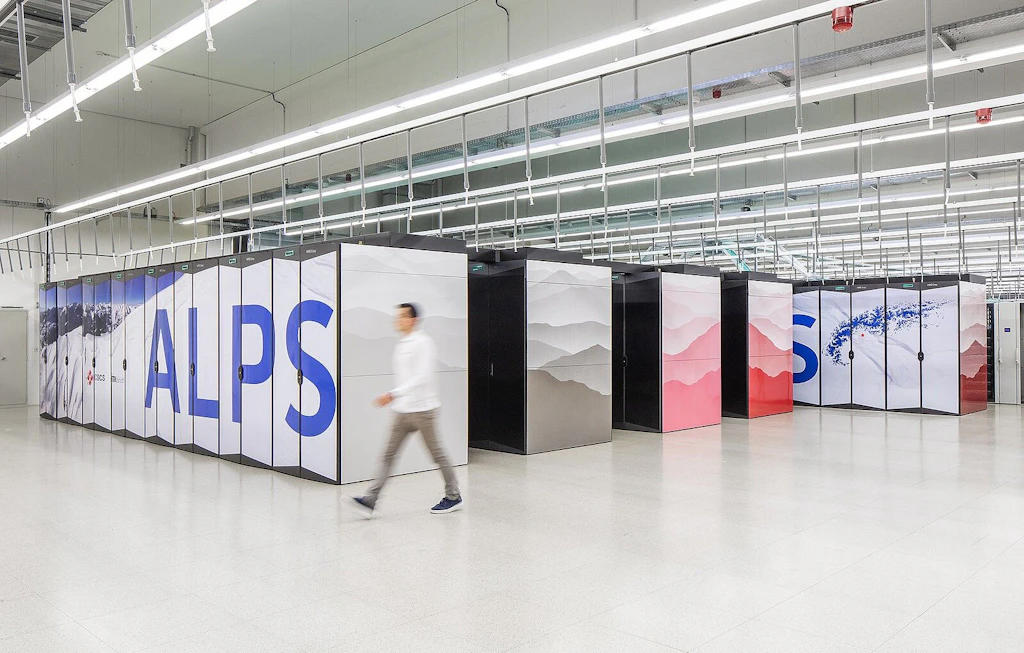
Switzerland's AI ambitions are supported by advanced computing infrastructure. The ALPS supercomputer, operated by the Swiss National Supercomputing Centre (CSCS), is one of Europe's most powerful supercomputers. It is used to train AI models and run complex simulations in fields such as climate science, physics and life sciences. These capabilities allow researchers to process large datasets and accelerate scientific discovery. Projects such as Apertus – Switzerland's first large-scale, fully open, multilingual language model – are being developed within this environment. Their focus is on open science, transparency and multilingual AI systems.
The International Computation and AI Network (ICAIN) also plays an important role in this context. Supported by Switzerland, ICAIN is a strategic initiative to promote trusted, sovereign and fit-for-purpose AI. The network plugs world-class compute (CSCS), leading research institutions (ETH Zurich, EPFL), and international partners into a collaborative platform for public-good AI. It lowers barriers to advanced capabilities so that governments, international organisations and researchers can build and operate AI systems on their own terms, with transparency and interoperability at the core.
How Switzerland turns AI research into startups
Switzerland's strength also lies in its ability to transform scientific research into real-world applications. AI is now one of the leading sectors among spin-offs created from ETH Zurich research. This reflects a strong pipeline connecting academic research, entrepreneurship and investment. Switzerland has ranked first in the Global Innovation Index for more than a decade, highlighting the close links between research, talent and innovation. The country's innovation ecosystem also helps attract international researchers, engineers and entrepreneurs in a highly competitive global AI landscape.

Geneva and the future of global AI governance
Beyond research and innovation, Switzerland plays an important role in shaping how AI is governed internationally. Geneva has long been a global centre for diplomacy and international cooperation. The city hosts international organisations, diplomatic missions and non-governmental actors working on digital governance and technology policy. Institutions such as the International Telecommunication Union (ITU) and the International Organization for Standardization (ISO) contribute to defining international standards in areas including telecommunications, cybersecurity and data governance. Platforms such as the Geneva Internet Platform also support international dialogue through research, analysis and capacity-building in digital policy.
Switzerland's approach to AI governance
Switzerland promotes a multistakeholder approach to AI governance. Governments, academia, the private sector and civil society are all involved in discussions about digital regulation and international cooperation. This approach builds on Switzerland's long tradition of dialogue and mediation. Since the World Summit on the Information Society in 2003, Geneva has remained a key location for discussions on the future of the digital world. Swiss digital foreign policy supports open digital spaces, international cooperation and respect for fundamental rights online.
A global AI summit in Geneva in 2027
AI is evolving rapidly, and Switzerland continues to position itself at the intersection of research, innovation and governance. At the AI Impact Summit in February 2026 in New Delhi, President of the Swiss Confederation Guy Parmelin officially announced that Switzerland will host the 2027 AI Summit in Geneva. The event is expected to bring together governments, researchers, technology companies and international organisations to discuss the future of AI and global digital cooperation.
Frequently asked questions (FAQ) about AI in Switzerland
-
The Swiss AI Initiative of national collaboration was launched by ETH Zurich and EPFL to strengthen Switzerland's AI research capacity and develop large-scale AI models.
-
Geneva hosts many international organisations and diplomatic institutions involved in digital governance, international standards and multilateral cooperation.
-
ALPS is one of Europe's most advanced supercomputers. It supports AI research and scientific simulations at the Swiss National Supercomputing Centre.
-
Switzerland combines world-class universities, advanced infrastructure, strong startup ecosystems and international cooperation, making it an important player in AI.